TL;DR
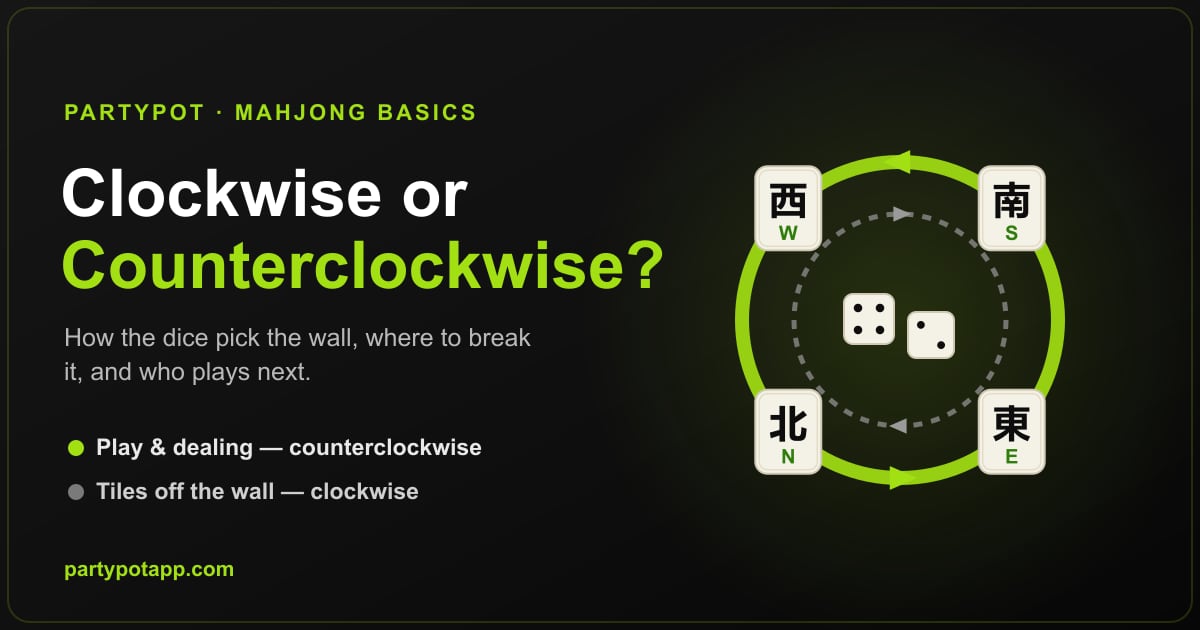
Mahjong runs in two directions at once. Play and dealing move counterclockwise — the seats go East → South → West → North and each turn passes to the player on your right. But tiles are drawn off the wall clockwise. The dealer's dice roll decides which wall to break and where, and you always count from the right end of a wall.
From the table
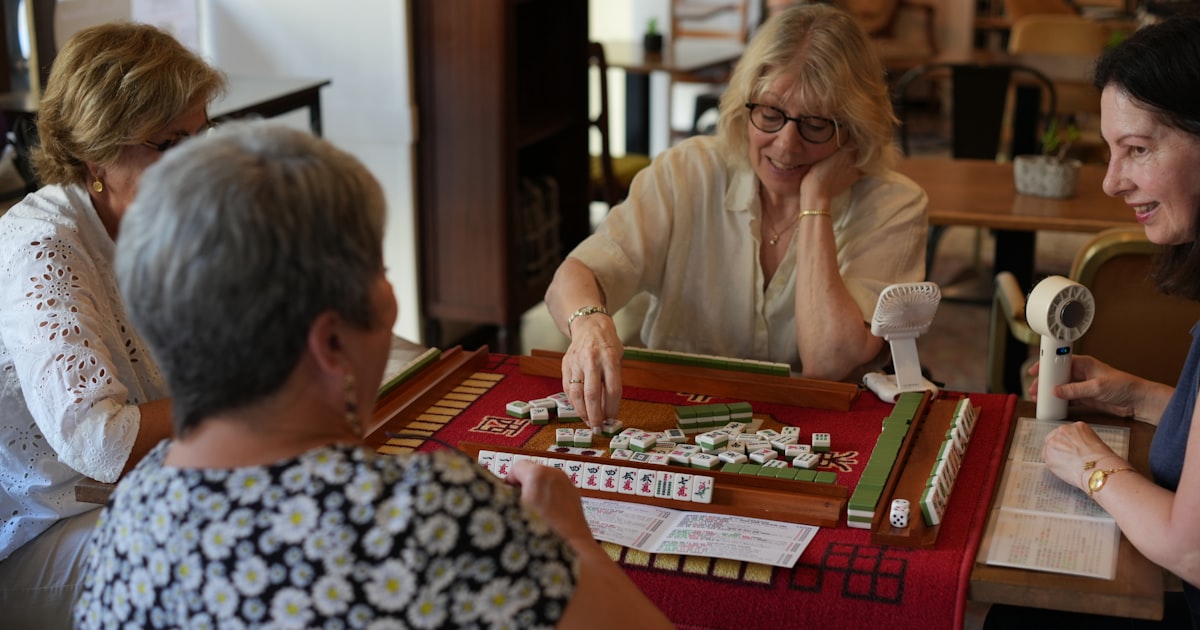
The first time I sat down at my in-laws' mahjong table in KL, I broke the wall from the wrong end and started dealing the wrong way round. Nobody was angry — they just laughed and re-stacked it. The rule that finally stuck for me: people go one way (to the right), tiles come off the other way. Once you separate those two directions in your head, the whole opening makes sense.— PartyPot team
“Is mahjong clockwise or counterclockwise?” is one of the most-asked beginner questions, and the reason it's confusing is that both answers are correct depending on what you're tracking. The order of play moves one way; the tiles leave the wall the other way. This guide walks through every direction in the opening of a hand — the seat winds, the dice roll, breaking the wall, dealing the blocks, and whose turn comes next — and notes where Hong Kong, Singapore, Taiwanese, and Japanese Riichi tables differ. (Spoiler: the direction barely changes between variants; what changes is the dice count and the tile total.)
Is Mahjong Played Clockwise or Counterclockwise?
Play is counterclockwise. After the dealer (East) makes the first discard, the turn passes to the player on their right, then the next player on the right, and so on around the table. The seat winds rotate in the same counterclockwise order: East, South, West, North.
Drawing tiles off the wall is clockwise. The wall is a continuous loop of face-down tiles. As players take their tiles, the wall is “eaten” in a clockwise sweep — the opposite direction to the turn order. This is the detail that trips people up: the two motions run against each other, on purpose, so the draw point keeps moving steadily around a wall that players are consuming from the front.
Think of it as two arrows: a bold counterclockwise arrow for people (turns, seating, dealing order) and a quieter clockwise arrow for tiles (the order they come off the wall). Hold those two apart and nothing else about the opening is hard.
The Seats: Why the Winds Go East → South → West → North
Every player is assigned a seat wind. The dealer is always East. Going counterclockwise — to East's right — the seats are South, then West, then North. The player to your immediate right always holds the next wind in the sequence, which is the same person who plays after you.
| Your seat | Plays next (to your right) | Role |
|---|---|---|
| East (東) | South | Dealer — rolls the dice, draws first |
| South (南) | West | Plays after East |
| West (西) | North | Plays after South |
| North (北) | East | Plays after West, then back to the dealer |
When East's turn comes back around as dealer, the table has completed one round. The dealer button passes counterclockwise to South only when East loses a hand (rules vary on whether a drawn or dealer-won hand keeps the deal) — but for the question of direction, everything moves the same way: to the right.
The Dice Roll: Which Wall Do You Break?
Before any tiles are dealt, all four players build their walls — each a row of face-down tiles two high. In most Chinese and Japanese sets that's 17 stacks (34 tiles) per wall; Taiwanese 16-tile mahjong builds longer walls. The four walls are pushed together into a square.
The dealer then rolls the dice. Hong Kong tables traditionally use three dice; Chinese and Japanese Riichi use two — but the number of dice doesn't change the method. You add up the pips and use that one total twice:
- Pick the wall. Starting with the dealer as “1,” count that many players counterclockwise (East → South → West → North → East …). The player you land on is whose wall gets broken.
- Find the break point. On that player's wall, count the same total in stacks from the right end, moving left. The gap opens just past the last counted stack.
Worked example — a roll of 6
East rolls a 4 and a 2 = 6. Counting counterclockwise from the dealer: 1 = East, 2 = South, 3 = West, 4 = North, 5 = East, 6 = South. So you break South's wall. Then count 6 stacks from the right end of South's wall and break the wall there. The first tiles are drawn from the stacks immediately to the left of that gap.
That's the common single-roll method. Some tables (and many Chinese rule books) use a two-roll variant: the dealer's roll only chooses the player, then that chosen player rolls again and you add both totals before counting stacks from the right. Either way the counting direction is identical — counterclockwise to pick the wall, right-to-left to find the gap. Agree on which method your table uses before the first hand so there's no argument.
Breaking the Wall — and the Dead Wall You Set Aside
“Breaking the wall” just means opening a gap at the spot the dice chose. Dealing then proceeds from the live side of the gap, and because the wall is a square loop, the draw rolls clockwise around the table even though the players taking tiles are going counterclockwise.
Many styles also reserve a dead wall (also called the kong box) — a fixed block of tiles set aside on the other side of the break that players cannot draw into during normal play. It supplies replacement tiles when someone declares a kong (four of a kind) or, in Chinese and Southeast Asian games, draws a flower or season tile. A common convention is 14 tiles (7 stacks). Japanese Riichi formalizes this: the dead wall is always 14 tiles, and one is flipped face-up as the dora indicator. Casual Hong Kong tables often keep it looser, simply drawing replacements from the tail end of the wall.
Taking the Tiles: Dealing in Blocks of Four
Tiles are not dealt one at a time. Starting with the dealer and going counterclockwise, each player takes a block of four tiles (two stacks of two) at a time. You go around the table this way until everyone holds 12 tiles. Then the hand is topped up:
- The dealer takes two more tiles (often the 1st and 3rd from the next stacks — the classic “jump” grab) to reach 14.
- Each other player takes one more to reach 13.
The dealer's 14th tile is the one they discard to start the game — which is why East always acts first. Everyone else plays the rest of the hand by drawing one and discarding one on their turn.
| Variant | Tiles per hand | Dealer starts with |
|---|---|---|
| Hong Kong / Cantonese | 13 | 14 (draws + discards first) |
| Singapore / Malaysian | 13 | 14 |
| Japanese Riichi | 13 | 14 |
| Taiwanese (16-tile) | 16 | 17 |
| 3-player (sanma / HK 3p) | 13 | 14 (one suit or a player removed) |
Whose Turn Is It? Play Passes to Your Right
Once the deal is done, a turn is simple: draw one tile, then discard one. Play then passes counterclockwise to the player on your right. The draw comes from the live wall, continuing the clockwise consumption from where dealing left off.
The one thing that can jump the order is a claim. If you can use a discarded tile, you may interrupt the normal rotation:
- Pung / Pong (three of a kind) and Kong (four) can be claimed by any player from any discard.
- Chi / Chow (a run/sequence) can usually only be claimed from the player on your left — the person who just played before you.
- After a claim, play resumes counterclockwise from the claimer. A player whose turn was skipped doesn't get it back.
So the default is always “to the right,” and claims only ever pull a turn forward, never reverse the table's direction.
Does the Direction Change Between Variants?
No — turn order is counterclockwise in essentially every mainstream variant, and the dice are always counted counterclockwise from the dealer. What actually differs between tables is the count, not the direction:
| Variant | Turn order | Dice | Dead wall |
|---|---|---|---|
| Hong Kong | Counterclockwise | 2 or 3 | Loose / tail of wall |
| Singapore / Malaysian | Counterclockwise | 2 or 3 | Often reserved for flowers/animals |
| Japanese Riichi | Counterclockwise | 2 | Fixed 14 tiles + dora |
| Taiwanese 16-tile | Counterclockwise | 2 | Reserved for replacements |
If you can play one variant's opening, you can sit down at any of the others and follow the direction without re-learning it. For the full points side of the game, see our beginner's guide to mahjong scoring and the variant rundown on our mahjong game guide.
Where PartyPot Fits — It Handles the Money, Not the Rotation
Worth being clear about this, because it's a common misconception: PartyPot does not roll the dice, pick the wall, deal the tiles, or track whose turn it is. Mahjong is a physical game and the table handles all of that — dice, walls, dealer rotation, who goes first. PartyPot doesn't score faan/tai either; there's no fan calculator inside it.
What PartyPot is is a money-only temporary wallet for the real table. Players agree their own table rate, transfer preset amounts to each other after each hand (the loser pays the winner, or all three pay on a self-draw), and at the end the app settles who pays who in the fewest transfers. Because it only moves money, it works for every variant on this page — Hong Kong 4-player, 3-player, Singapore, Riichi, sanma — without knowing a single rule about tiles or direction.
- Set your own point value per hand — PartyPot doesn't impose a scoring system.
- Self-draw, win-by-discard, or a fully custom payout — you enter the transfer, it tracks the running balances.
- One audit log for the whole session, so there's no “wait, did you pay that hand?”.
- Prefer to do the math first? Try the free mahjong payout calculator — enter each player's net result and it returns who pays who. (More on this in our mahjong FAQ.)
Get Party Pot — the Money Banker for Mahjong Night
Free. No ads. No account. Play mahjong your way — let Party Pot track the wins, losses, and the final who-pays-who.
Related reading: Mahjong Scoring Made Simple for fan, payments, and who-pays-whom; Best Card Games for Chinese New Year for the rest of the reunion-table lineup; and the PartyPot mahjong game guide for variant-by-variant rules.
People to the right, tiles off the left — now go break the wall. 🀄