TL;DR
In American mahjong, every hand on the NMJL card has a printed value — usually 25 to 50 points, played as cents. When someone wins, all three opponents pay that value; the player who discarded the winning tile pays double, and a jokerless hand doubles the payout again. Most tables cap losses with a small “pie” — typically $5 per player.
From the table
We built PartyPot's mahjong mode for the tables we grew up with — Hong Kong and Singapore style, faan and tai argued out loud over supper. Then American players started writing in, and the requests looked completely different: nobody asked us to score anything, because the NMJL card already prints the value on every hand. What they wanted was the part we'd already solved — moving the quarters without a dish of coins on the table.— PartyPot team
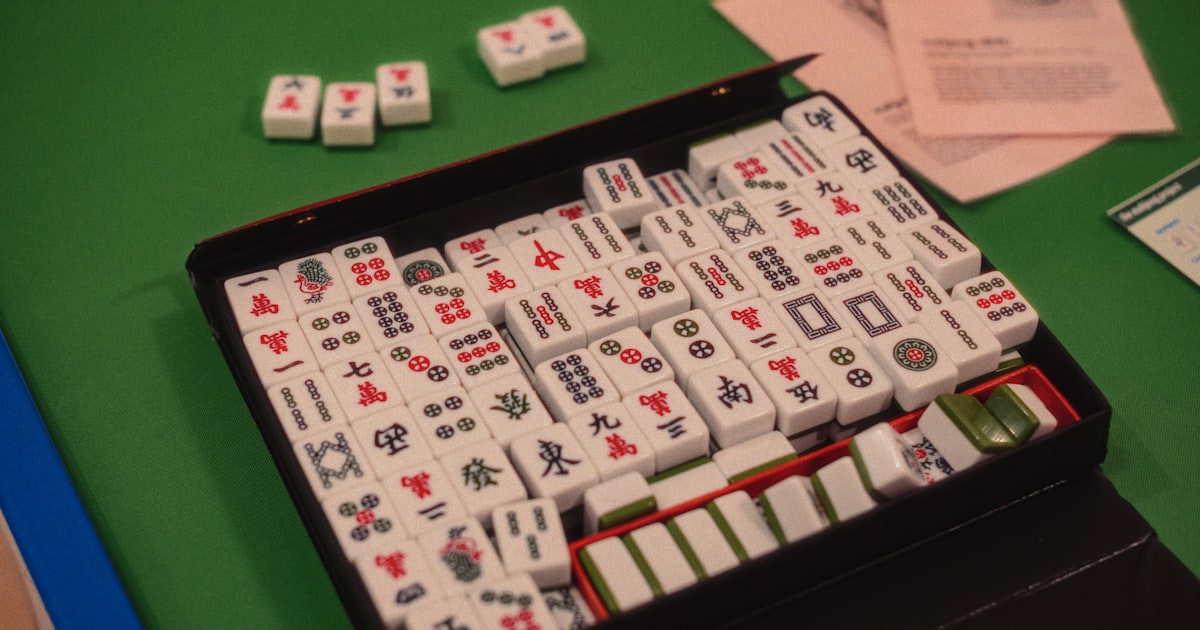
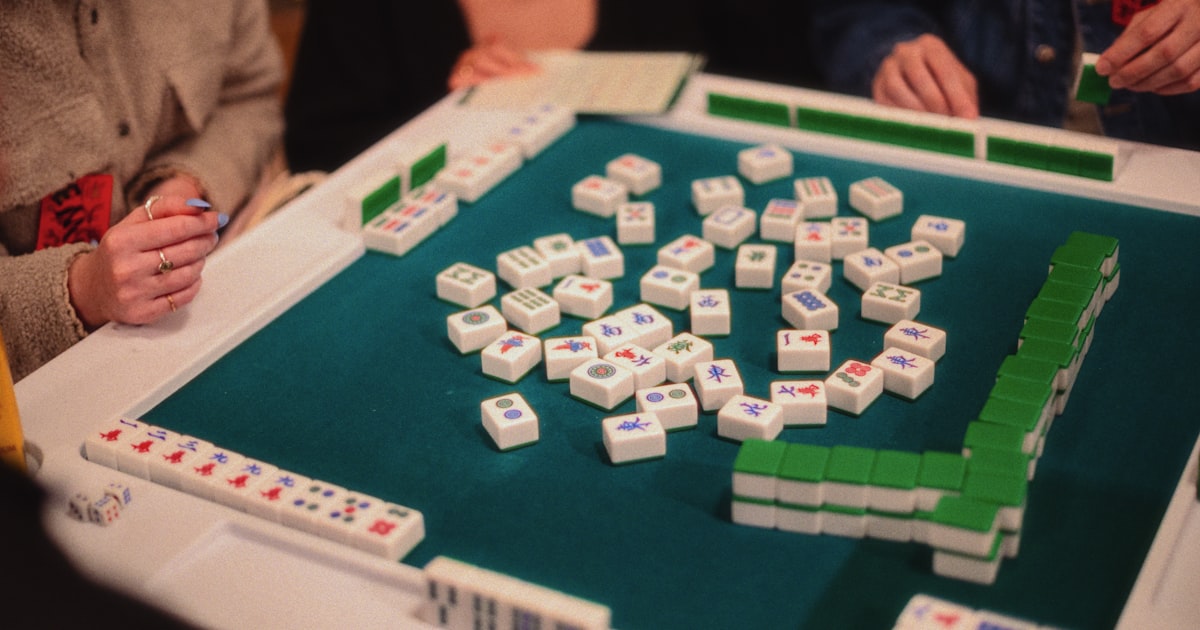
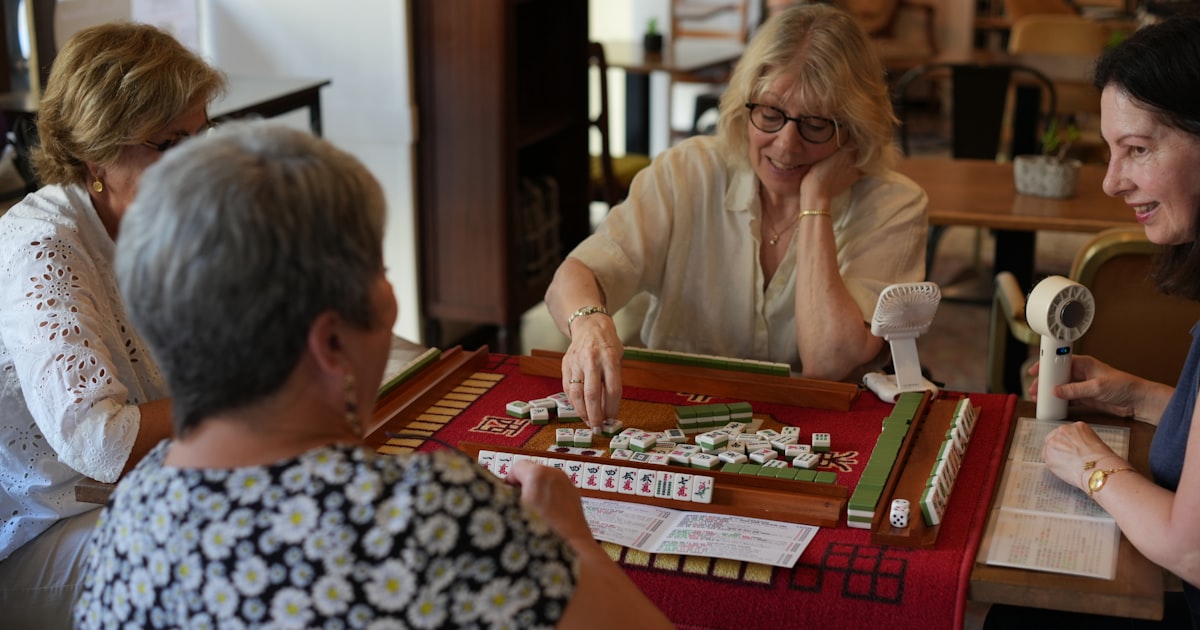
American mahjong — the National Mah Jongg League (NMJL) version played with jokers, the Charleston, and that famous annual card — is having a genuine moment. Yelp named mahjong one of its top trends of 2026, with searches for mahjong clubs up more than 4,400% year over year. Which means thousands of brand-new players are sitting down at their first money game and quietly wondering the same thing: how does the money actually work? This guide covers the whole money side — what hands are worth, who pays what, the jokerless bonus, and the “pie” rule that keeps the stakes friendly.
How Does Money Work in American Mahjong?
Unlike Hong Kong or Riichi mahjong, where the table has to count fan or yaku before anyone gets paid, American mahjong settles the question in print. Every hand on the NMJL card carries a fixed point value, and at most tables one point equals one cent. The common lines on the card are worth 25, 30, 35, 40, 45 or 50 — so a “25” hand is a 25¢ hand, and the rarer, harder sections (Singles and Pairs, big special hands) are worth more.
When a player declares mahjong, she announces the value of her hand and collects from all three opponents at once. There is no shared pot and no banker holding cash — American mahjong is a player-to-player payment game, which is exactly why the classic table setup includes a pile of quarters next to everyone's rack.
Because the card resets every year (the NMJL publishes a new one each spring), the values can shift slightly between years, but the payment system below has been stable for decades.
Who Pays What: The Four Payout Situations
The amount each opponent owes depends on two things: how the winning tile arrived (discard or self-pick) and whether the winning hand used any jokers. Here is the standard structure:
| Situation | Discarder pays | Other two pay | 25¢ hand example |
|---|---|---|---|
| Win on a discard | 2× value | 1× value | 50¢ + 25¢ + 25¢ = $1.00 |
| Self-pick (drawn from the wall) | — | All three pay 2× | 50¢ × 3 = $1.50 |
| Jokerless win on a discard | 4× value | 2× value | $1.00 + 50¢ + 50¢ = $2.00 |
| Jokerless self-pick | — | All three pay 4× | $1.00 × 3 = $3.00 |
Two footnotes that save arguments. First, the jokerless doubling doesn't apply to hands that can't use jokers anyway — Singles and Pairs hands, and the pairs within any hand, are joker-free by definition, so most tables exclude them from the bonus. Second, the winner announces what each player owes; if she miscounts, it's on the table to catch it before the coins move. The discarder-pays-double rule is also why experienced players get cagey late in a hand — throwing the tile that completes someone's 50-point hand costs you a dollar, not a quarter.
What Is “the Pie” in American Mahjong?
The pie is the rule that keeps American mahjong a social game instead of a gambling one. Each player brings a fixed amount — most commonly $5, with groups ranging anywhere from $3 to $10 — and that's the absolute most she can lose in a session. When your pie is gone, you keep playing; you just stop paying. Winners still collect from the players who have money left.
It's a table rule rather than an official NMJL regulation, so confirm it before the first hand, the same way a poker table confirms the buy-in. A few practical conventions we've seen work well:
- Declare the pie before the Charleston starts. “Five-dollar pie” takes three seconds to say and prevents every downstream dispute.
- Pay as you go, hand by hand. Letting debts pile up to “settle later” is how friendly games end with someone doing algebra at 11pm.
- Track who's “out of pie.” A player with an empty pie pays nothing — but the other two still owe full freight when someone wins. This is the bit that gets miscounted most.
A typical evening with a $5 pie moves somewhere between $5 and $20 across the table — real enough to make a jokerless self-pick feel glorious, small enough that nobody texts the group chat about it the next day.
Quarters, Chips, or an App: Three Ways to Move the Money
Coins (the classic)
The traditional setup is a stack of quarters, dimes and nickels next to each rack. It works, and the clink is part of the nostalgia — but someone has to arrive with $5 in change for four people, and a 25¢-equals-one-point game generates a lot of coin-passing across a crowded table of tiles.
Chips
Many sets ship with plastic chips, and some groups borrow poker chips with agreed values. Cleaner than coins, but now you're reconciling chips back to dollars at the end of the night — and a chip bank still can't tell you whose memory of hand six is correct.
A money-tracking app
The modern option is to keep the tiles physical and make the money digital. Each player starts the session with her pie as a balance, the winner gets paid the right amounts in two taps after each hand, and the running totals — including who's out of pie — are on everyone's phone. At the end, the ledger says exactly who hands whom what, once. (More on how that works in PartyPot below; for the general approach, see our digital mahjong tracking FAQ.)
A Worked Example: Four Players, Three Hands
Ruth, Carol, Dana and Mei sit down with a $5 pie each, one point = one cent:
- Hand 1: Ruth wins a 30¢ hand on Carol's discard. Carol pays 60¢; Dana and Mei pay 30¢ each. Ruth is +$1.20.
- Hand 2: Mei self-picks a 25¢ hand. Everyone pays double: Ruth, Carol and Dana each pay 50¢. Mei is +$1.50 on the hand.
- Hand 3: Dana wins a jokerless 50¢ hand on Mei's discard. Mei pays $2.00; Ruth and Carol pay $1.00 each. Dana is +$4.00.
After three hands: Dana +$2.70, Mei +$0.20 net, Ruth −$0.60, Carol −$2.30 — and that's only three hands of bookkeeping. A real session runs a dozen or more, which is why the end-of-night “wait, how much do I owe you?” conversation is a fixture of mahjong night. If your group settles at the end rather than per hand, a free mahjong payout calculator turns everyone's net result into the shortest list of who-pays-who.
Quick Answers to the Money Questions Every New Table Asks
Does the dealer pay or collect more?
No. Unlike Hong Kong, Singapore or Riichi mahjong — where East's wins and losses are often scaled up — American mahjong has no dealer premium. East deals, the Charleston happens, and the money rules treat all four seats identically.
What happens on a wall game?
If the wall runs out before anyone declares mahjong, the hand is dead: no money moves. Shuffle, pass the deal, play on. (Some tables invent a carry-over bonus for the next winner — that's a house rule, so agree on it up front.)
What if a fifth person wants in?
NMJL rules have an elegant answer: the fifth player sits as the Bettor. Before each hand she privately picks the player she thinks will win, then shares that player's fate — collecting when her pick wins, paying when her pick pays. It keeps a full house involved with zero extra tiles.
What if two players are out of pie?
The hand plays on normally — winners simply collect from whoever still has money. A 25¢ win late in the evening might only pay 50¢ instead of 75¢. That asymmetry is by design; it's the pie doing its job of capping the damage rather than a bookkeeping error.
Where PartyPot Fits: It Moves the Quarters, You Play the Card
To be precise about what the app does and doesn't do: PartyPot doesn't know the NMJL card, doesn't validate hands, and doesn't score anything. It's a money-only temporary wallet for a real table. You declare mahjong, the table agrees what's owed — exactly as you would with coins — and the payments happen in the app instead of in quarters.
- Everyone starts with their pie as a balance — $5.00, $3.00, whatever your table plays.
- Preset transfer amounts handle the standard payouts (25¢, 50¢, $1.00, $2.00) in a tap.
- The running balance shows instantly who's up, who's down, and who's out of pie.
- Every payment lands in an audit log, so “did Carol pay hand six?” has an answer.
- It works identically for every mahjong variant — American, Hong Kong, Singapore, Riichi — because players set their own values.
And since it's the players deciding the amounts, the same room handles the table that plays nickel stakes and the one that plays dollar hands without changing a setting.
Get Party Pot — the Money Banker for Mahjong Night
Free. No ads. No account. Keep the tiles, the card, and the Charleston — let Party Pot handle the quarters and the final who-pays-who.
Related reading: Mahjong Scoring Made Simple for the fan-based Asian scoring systems this card-based game replaced; Is Mahjong Clockwise or Counterclockwise? for table direction and the opening deal; and how to split mahjong winnings fairly for end-of-session settlement.
Photo by Ryo Tanaka on Unsplash.
Read the card, watch your jokers, and may your self-picks be jokerless. 🀄